Missed-call text-back: what it is
A Charlotte electrician found 61% of calls went unanswered. Discover how missed-call text-back works and why it books jobs at 38%+.
Marcus runs a 3-crew electrical shop in Charlotte. Business is solid, he stays busy, and he figured his 18% booking rate on inbound calls was about right for the market. Electrical is competitive in Charlotte. Some calls convert, some don’t. He wasn’t losing sleep over it.
Then we pulled 30 days of call logs from his business line. 214 inbound calls. 84 answered. The other 130 went unanswered, most of them without a voicemail. His effective answer rate was 39%. His booking rate of 18% was calculated against the calls he actually picked up, not against the 214 that came in. Against the full call volume, his real booking rate was closer to 7%.
He had 130 leads per month disappearing into silence. He had no system to catch them.
Operator details anonymized. Based on a real LeadExploder account matching this profile.

Missed-call text-back is the system.
What actually triggers a missed-call text-back?
The trigger is simple: a call comes in to your business line and goes unanswered. That means the call rang through without anyone picking up, went to voicemail, the caller hung up before the voicemail greeting finished, or the line was busy. Any of those outcomes fires the automation.
Within 8 seconds, an SMS goes out from your business number to the caller’s number. Not from a shortcode. Not from a marketing platform. From your actual business number, the same one they just called. On the caller’s end, it looks like you texted them back immediately.
The trigger does not fire if the call was answered. It does not fire if the caller ID is blocked. You can configure it to fire only during certain hours (after-hours only, for example) or for all missed calls regardless of time. Most home-service businesses run it 24 hours because emergency calls don’t follow business-hour logic.
What does the message look like?
The message needs to do one thing: open a conversation. Not explain your business. Not list your services. Not link to your website. Open a conversation.
The messages that work are short, sound like a person, and ask one specific question:
Hey, this is Marcus at Charlotte Electric. Sorry I missed you. What’s going on and what part of Charlotte are you in? I’ll get someone out there.
That is 22 words. It tells the caller who you are, acknowledges the missed call without making it a big deal, and asks two pieces of information your team needs to book the job: the nature of the problem and the location.
The message that does not work sounds like this: “Thank you for contacting Charlotte Electric. We value your business. Please visit our website to schedule an appointment or leave us a detailed message.” That is a press release. Nobody responds to a press release.
For a library of ready-to-use templates by vertical, the text-back templates post has five complete versions including HVAC, plumbing, roofing, dental, and law firm, plus an analysis of what makes each one convert.
Why does 8 seconds change the outcome?
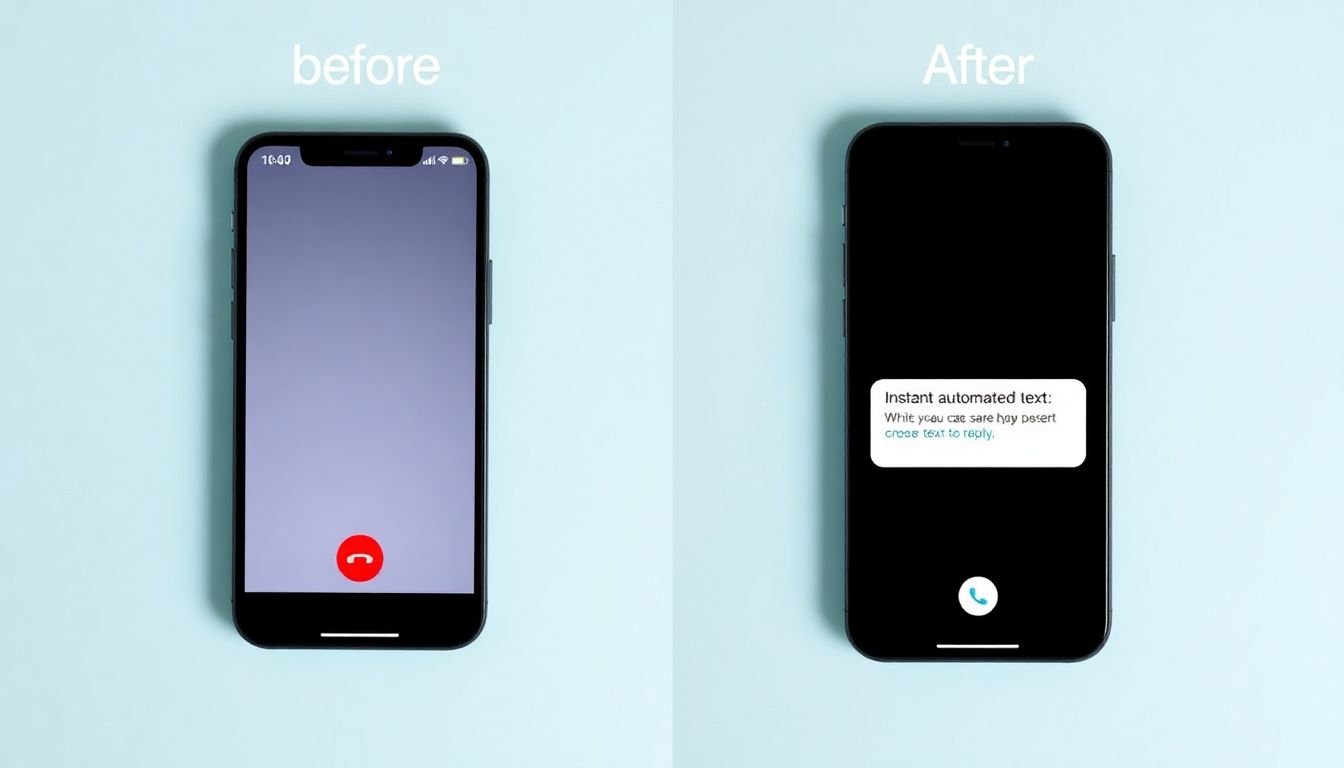
When a call goes unanswered and hits voicemail, the caller makes a fast decision in the next 60 to 90 seconds. They either leave a message and wait, or they move on. Hiya’s 2024 State of the Call Report (hiya.com) found that 80% of callers do not leave a voicemail. That means 4 out of 5 callers are moving on.
“Moving on” means scrolling down on Google and calling the next result. Or asking Alexa. Or texting a neighbor for a referral. The window is 90 seconds. After that, your lead has engaged with a competitor and that competitor is now first in their mental queue.
An 8-second text-back intercepts them inside that 90-second window. At 8 seconds, the caller just put their phone down. They probably haven’t opened the next Google result yet. They haven’t decided you’re unreachable. They just heard a voicemail.
When a text arrives 8 seconds later, the psychological experience changes entirely. The caller does not experience a missed call followed by a recovery. They experience a business that replied instantly. That is a completely different first impression.
How carrier filtering works and how to stay out of spam
A text-back only works if it lands in the main SMS inbox, not in a spam filter or a blocked-sender bucket. Carrier filtering, especially on T-Mobile and AT&T, has become more aggressive over the last two years. Here is what triggers it and how to avoid it.
Filtered messages typically share one or more of these patterns: they come from a shortcode rather than a 10-digit business number, they contain words flagged as commercial spam (“free,” “guaranteed,” “prize,” “win,” “click here,” “limited time”), they include URLs from generic link shorteners like bit.ly or tinyurl, or they send at very high volume from a single number in a short window.
For a single-location service business, the spam filter risk is low if you follow three rules. First, use your business’s 10-digit number, not a shortcode. Shortcodes are fine for bulk marketing but look like spam to carriers when used for one-on-one message triggers. Second, write the message in plain conversational language. The template above (22 words, no links, no promotional framing) will not trigger a filter. Third, do not fire more than one text-back per contact per 24-hour window. If the same number calls twice in a day, only the first missed call triggers the text. A second text to the same number in the same day looks like harassment to both carriers and callers.
LeadExploder handles the carrier compliance layer automatically, including 10DLC registration for your business number. If you are setting this up manually, check whether your number is 10DLC registered before you go live.
What happens when the same number calls multiple times in one day
This situation comes up more often than it seems. A homeowner calls at 10 AM, gets the text-back, sees it, and doesn’t reply because they’re in a meeting. At 2 PM, they call again. Without a guard on the trigger, they would receive a second text-back, which looks automated and reduces trust.
The right behavior: if the same number has already received a text-back in the last 24 hours and has not replied, suppress the second text-back. Instead, route the second missed call to your team as a priority alert: someone called twice and hasn’t been reached. That is a warm lead who is persistent and motivated. A human callback within 30 minutes will close this one.
If the caller did reply to the first text-back but the conversation never reached a booking, a second call from them should trigger a different response: not the opening template, but a pickup of the existing thread. “Hey, saw you called again. Did you still need to get that taken care of? I can have someone out today.”
How the overnight queue works for 2 AM replies
The text-back fires around the clock. Which means a reply can come in at 2 AM. Here is how the system should handle it.
When a lead replies to a text-back during overnight hours (typically configured as 10 PM to 7 AM), the conversation enters a queue rather than a live inbox. The reply is saved, a contact record is created with a timestamp, and an internal alert fires to whoever is on the on-call list. That alert is not a full notification blast to your whole team. It is a targeted ping to the on-call tech’s phone: “After-hours lead replied. Address: [address]. Issue: [issue text from their reply].”
The on-call tech has two options. If it is a genuine emergency (no water, no AC in extreme heat, no heat in a freeze), they respond immediately and dispatch. If it is a non-emergency that can wait, they acknowledge the lead with a brief message (“Got your message. We’ll have someone out first thing in the morning around 7:30. I’ll confirm then.”) and the conversation resumes at open.
The overnight queue prevents two bad outcomes: your whole team getting woken up for a non-emergency, and an after-hours lead receiving silence until 8 AM the next day. If why most service business calls go unanswered is new to you, that post explains the overnight lead problem from the caller’s perspective and why a morning callback is rarely enough to recover the job.
How text-back differs from a missed-call voicemail drop
These are two different tools that are sometimes confused.
A voicemail drop pushes a pre-recorded message into the caller’s voicemail box without ringing their phone. It is typically used for outbound prospecting: your sales rep presses a button and a message lands in 50 people’s voicemails at once. The caller never received a call. They just find a voicemail from you.
Missed-call text-back works in the opposite direction. The caller initiated contact with you. You missed their call. The text-back is your response to their attempt to reach you. The caller is warm, they have a problem, and they chose to call you first. A voicemail drop is cold outbound. A text-back is warm recovery.
The practical difference in reply rates reflects this: voicemail drops for outbound prospecting typically see 3% to 8% callback rates. Missed-call text-back sees 38% to 45% reply rates in home-services accounts because the lead is already mid-decision when the text arrives. They called you. They just couldn’t reach you. The text gives them an easy path back into the conversation.
Why does a text convert better than a callback the next morning?
Callbacks at 9 AM the next morning are not lead recovery. They are post-mortem.
The caller at 2 PM who had a flickering breaker panel was at peak concern at 2 PM. By 9 AM the next morning, one of three things happened: they called someone else and scheduled the job, they looked it up online and decided it wasn’t urgent, or they solved it themselves. Their urgency is gone. Your callback is an interruption.
A text at 8 seconds is a different situation entirely. The caller is still at peak concern. They’re still holding the phone. They had a problem that motivated them to look up electricians, find your number, and call you. That motivation doesn’t evaporate in 8 seconds. But it does evaporate in 12 hours.
There’s a secondary reason texts convert better than callbacks: channel preference. A significant share of service callers, especially the 25-to-45 demographic that makes most home-service decisions, prefer to manage initial logistics by text. They don’t want to talk through the problem on the phone at 2 PM when they’re at work. They want to say “my panel is buzzing and I smell something burning, I’m in Ballantyne” and let someone handle it. Text lets them do that.
What did the numbers look like for Marcus?
Marcus installed missed-call text-back and ran it for 30 days. Here’s what happened.
His call volume stayed the same: roughly 210 calls per month. His answer rate didn’t change significantly because his crew was still in the field. The difference was what happened to the calls he didn’t answer.
Of the 130-ish missed calls per month, 68 replied to the text-back. Of those 68, 26 booked a job. That is a 38% booking rate on recovered leads. At an average ticket of $380 for residential electrical work in Charlotte, that is $9,880 per month in revenue that previously went to voicemail.
His platform costs $497 per month. The math is not complicated.
The 18% booking rate he thought was normal wasn’t his conversion problem. His answer rate was his conversion problem. Missed-call text-back didn’t fix his sales process. It just made sure his sales process got a chance to run.
What to do this week
Pull your last 30 days of call logs and count how many calls went unanswered. Multiply that number by your average ticket and by 0.30. That is a conservative estimate of what you’re leaving on the table each month.
Book a demo and see missed-call text-back running live.
Alex Rocha is the founder of Mastodon Marketing, a Houston-based growth agency that runs marketing for service businesses across 70+ client sites. He built LeadExploder as the operating system he wished his clients had on day one. Learn more about Alex →
Frequently asked questions
What is missed-call text-back?
Missed-call text-back is an automated SMS sent from your business number within seconds of a missed call. The message opens a conversation with the caller while they still have their phone in hand, before they move on to the next competitor.
Why does 8 seconds matter for text-back timing?
At 8 seconds, the caller just put their phone down after hearing your voicemail. They haven't scrolled away yet. A text that arrives in that window feels like an instant response, not a recovery. After 60 seconds, they've already moved on.
Why does a text convert better than a callback the next morning?
A callback the next morning is not a recovery. The caller made a decision within 90 seconds of hanging up. They either left a voicemail and waited, or called the next business. An 8-second text intercepts them before that decision closes.
What booking rate should I expect from missed-call text-back?
Across home-services accounts, recovered leads that enter a text conversation book at 30% to 40%. The national average for cold inbound calls is lower because those leads come in at random readiness. Text-back captures leads at peak intent.